
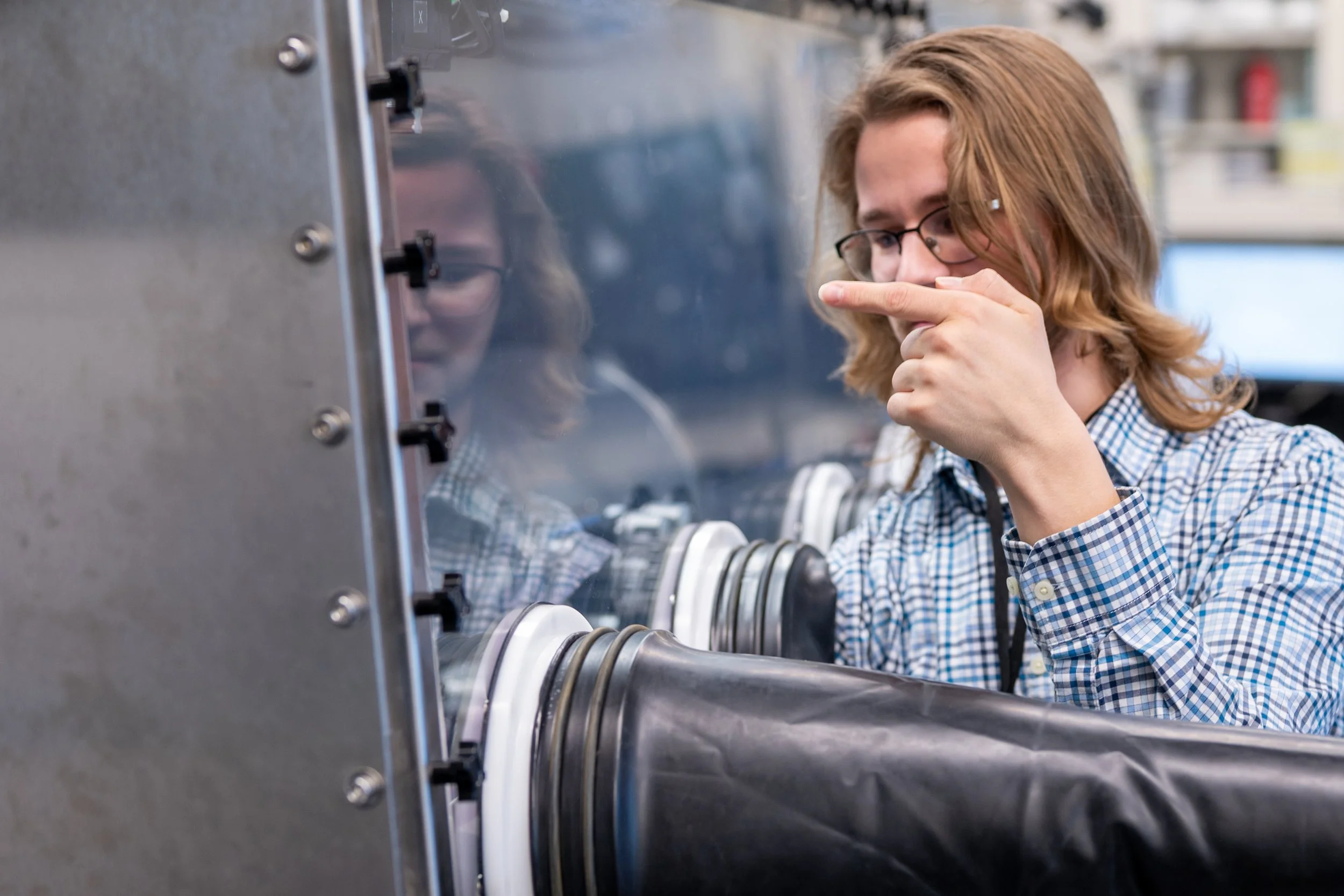
Development of 2D quantum materials pipelines (2D-QMaPs)
The MonArk Quantum Foundry has developed two prototypes of a 2D Quantum Material Pipeline (2D-QMaP), with one located at the University of Utah and the other at the University of Arkansas. These systems are being developed to provide automated capabilities that integrate and accelerate the three primary stages of sample preparation and device fabrication for 2D quantum materials research.
Pipeline Overview

-
Custom robotic exfoliating rollers automatically process bulk crystals into high-yield 2D monolayers and thin crystallites under controlled environmental conditions, protecting delicate atomic interfaces from ambient air degradation
-
Computer-controlled microscopes and machine vision rapidly scan target substrates, matching optical contrast against layered material libraries to verify layer thickness and automatically log spatial coordinates, flake boundaries, and optical spectra into a digital database
-
Automated pick-up and stacking apparatuses assemble van der Waals heterostructures and moiré superlattices with precise rotational twist-angle alignment, encapsulating active channels within protective dielectric layers like hBN to maintain high electronic mobility
-
Integrated transfer mechanisms move assembled samples seamlessly between exfoliation, stacking, and lithography stages inside an interconnected glovebox environment or via sealed vacuum suitcases, completely preventing parasitic exposure to moisture and oxygen
-
Thermal scanning probe lithography (NanoFrazor) and high-throughput laser writing (µMLA) pattern sub-50 nm device channels directly within the inert atmosphere, followed by integrated electron-beam metallization, sputtering, and packaging for immediate cryogenic testing
Design Principles
1. An interconnected, controlled environment. Capabilities will be integrated into an interconnected glovebox system to protect 2D quantum materials from exposure to water and oxygen. For systems that cannot be directly integrated, vacuum suitcases will enable safe material transfer while maintaining controlled environments.
2. Targeted automation and data-driven discovery. Robotic and machine vision automation will be applied to time-consuming, labor-intensive, and difficult-to-reproduce tasks, particularly in exfoliation and fabrication. Beyond improving efficiency and reproducibility, automation will enable the generation of large, systematic datasets to support the training and development of machine learning algorithms.